AI for CDFIs: Where to Start and Finding the Right Balance
Artificial intelligence has become a practical technology question for CDFIs rather than a distant one. Software providers are adding AI features to the platforms organizations already rely on, and many employees have begun experimenting with general-purpose tools on their own, often to research a topic or get a head start on routine materials.
The interest is understandable as CDFI organizations are expected to manage portfolios, support borrowers, satisfy funder requirements, and demonstrate impact while keeping daily operations moving, usually with lean staffing. When capacity is that limited, any tool that promises to reduce administrative work deserves a serious look.
That does not make every task a suitable place to begin. Rather than starting with which product to buy, leadership is usually better served by asking where AI could take on some of the effort in a process while leaving judgment with the people who are accountable for the outcome.
CDFI AI Adoption Is Still Taking Shape
It is easy to assume that peer organizations already have advanced AI programs in place, but the available research suggests otherwise. The FUND Community Institute’s From Curiosity to Capacity study surveyed 104 CDFI stakeholders in March 2026 and found an average self-reported adoption level of 3 out of 10. Thirty-two percent of respondents said they regularly use general-purpose AI tools at work, while 35 percent placed their organizations at the lowest level of adoption.
The same research indicates that AI is entering the sector through support-oriented work. Research was the most commonly reported use, followed by employee productivity and marketing, while adoption in underwriting and loan document processing remained considerably lower. This pattern offers a useful guide for CDFIs that are just getting started, since it shows how staff can build familiarity with AI in areas where a mistake would not reach a borrower or influence a credit decision.
Build the Foundation Before You Scale
The strongest early uses tend to address a real operating need while leaving the final judgment with an employee. In practice, this often looks like a staff member asking an approved tool to locate a specific policy provision or condense a lengthy document into a summary before a meeting. Turning meeting notes into a draft follow-up, outlining a presentation, and flagging inconsistencies in a set of documents for someone to investigate are similar examples, because each saves time while the employee remains responsible for what is ultimately used.
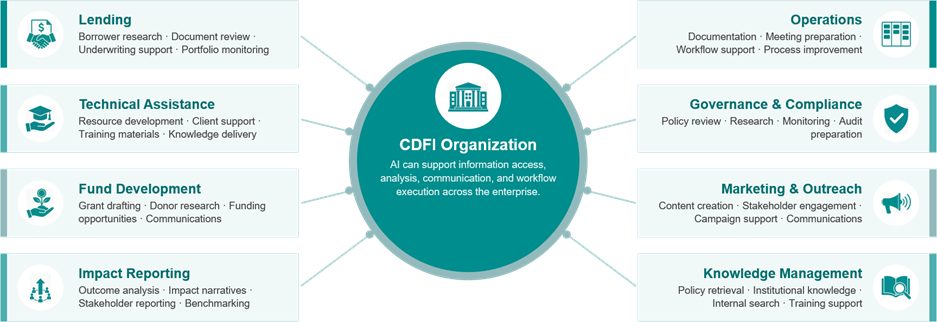
Preparation work of this kind exists in nearly every part of a CDFI. Lending staff spend considerable time reviewing documentation, technical assistance teams develop educational material for borrowers, and fund development staff assemble grant narratives and donor research. Operations and compliance staff maintain procedures and review policies, while impact teams gather information for funder reporting. In each case, the aim is to reduce the effort that surrounds professional responsibility rather than to hand that responsibility to a tool.
Choose a Manageable Place to Start
The best first use case is narrow enough to supervise closely, but valuable enough that staff can tell whether it actually improved their work. An internal administrative process that employees already know well is often the right place to start. Because the work is familiar, it is easier to see how people use the tool, where it gets things wrong, what information staff try to enter, and where they need more guidance.
Those early observations will inform future decisions far better than moving to a more complex use simply because the technology allows it. They also show leadership what guidance and controls staff will need as adoption expands.
Keep People Involved Where Judgment Matters Most
Even with a well-defined starting point, accuracy remains a central concern. AI tools have become remarkably capable, and they can save staff meaningful time by organizing information, drafting content, and surfacing insights that might otherwise take hours to assemble. That capability is exactly why human review matters. AI can deliver an answer with complete confidence even when it is inaccurate or based on information that does not apply to the situation, and the confidence of a response does not guarantee reliability. As employees grow more comfortable with these tools, leadership should reinforce that AI informs the work while people remain responsible for it, with a qualified reviewer checking each output before it is put to use.
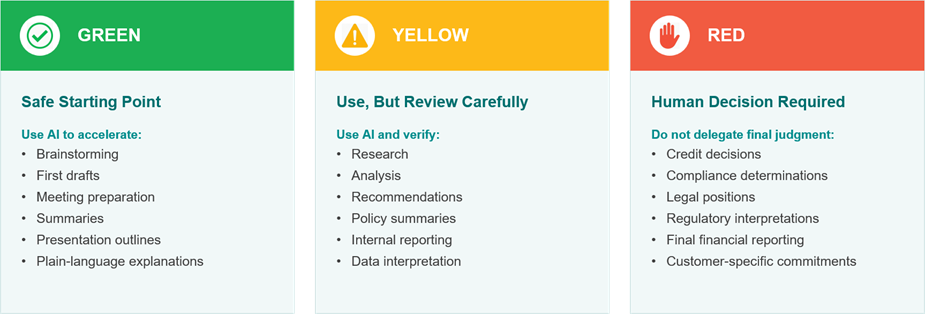
The level of review should depend on how an output will be used. A rough meeting agenda does not carry the same consequences as a policy interpretation or a credit recommendation, so scrutiny should increase as the stakes rise.
Brainstorming, first drafts, meeting preparation, and plain-language explanations are reasonable places for employees to learn. These outputs still deserve a careful read before they are shared, but the cost of an error is relatively low. Research, analysis, policy summaries, internal reporting, and data interpretation call for closer scrutiny, with a reviewer confirming the sources and testing the reasoning behind an output before anyone relies on it.
Some work should remain firmly in human hands. Final credit decisions, compliance determinations, legal and regulatory interpretations, financial reporting, and commitments made to specific customers can draw on AI to gather or organize information, but a named person should review the work and own the result.
Prioritize Value Over Complexity
The first goal of AI adoption should be to understand where the technology genuinely helps, while preserving the judgment and community knowledge that define CDFI work, rather than to transform the entire organization at once. Starting with preparation work instead of final decisions gives staff room to learn and gives leadership time to put the policies and training in place that more consequential uses will eventually require.
ATX works with CDFIs to evaluate technology opportunities in the context of their operations and organizational priorities. For organizations weighing where AI could provide practical value, a structured look at potential use cases and the safeguards each one would require is often the most productive place to begin.
For more information about ATX Advisory Services and our AI readiness services, please visit www.atxadvisory.com.
Authors: Paige Stolen, Katee Harrington